They say karma's a bitch, but Imposter Syndrome is a cruel bully

It's amazing how imposter syndrome will still continue to rear its ugly head no matter how many times I encounter it: in therapy, in journaling, accepting it head-on, or trying to run away from it.
What I do after each encounter with imposter syndrome may fluctuate each time, but it still visits me like a regular unwelcome guest. I will say, though, that if I choose a more responsible way of dealing with it, like journaling about it or talking with a therapist about it, then the length of stay and the frequency of the visits decrease.
When I try to run away from imposter syndrome, or just chug along with whatever I was doing that spawned its sudden appearance, the battle to be rid of it is much more emotionally labor-intensive.
So here I am, on this blog, actively trying to face it head-on, attempting to use my words as tools to unhook imposter syndrome's painful talons for today.
I think what spurred this version of imposter syndrome was starting a few new projects at once on platforms I'm unfamiliar with and comparing myself to those who are already well established. For example, a few weeks back, I was mulling over how to prove my Substack articles are not written with AI, and one terrible idea appeared briefly: I could record my computer and/or myself sitting at my desk, typing with my fingers, with the screen visible.
I nixed that idea immediately because I absolutely hate the idea of people seeing my first drafts for a few reasons, one of which is that my first draft is obviously not my very best effort, or else I would never need to edit. But a more significant reason was that I absolutely did NOT want the feeling of never being able to make a mistake in my first draft. When I draft, sometimes my thoughts aren't fully formed, or I leave big blanks to come back in and fill later, leaving notes to myself along the way, and honestly? I don't want to invite other people to intrude on this little communication I have with myself throughout the process. If I knew other people were watching my first draft, I'd never feel free enough to actually just get the damn words out on a page. I'd feel pressure to only come to the page with a fully fleshed-out draft.
So, long story short, I quickly decided that recording my writing was not going to be the way I would prove authorship of my work. But that did lead to the idea of recording my writing in other ways, which led me to start live-streaming my "Research & Marginalia," where I'd show up on Twitch and show my reading and annotating my sources with my annotation cam in the corner.
To this day, I still haven't seen anyone livestream annotation, so this is either an awesomely unique idea or an absolutely terrible one (why else would no one do it?)
But with all that said, joining a new platform with its own set of customs and technical difficulties is already hard enough; but also, calmly speaking live into the internet void is also scary. I'm not a sparkling conversationalist to begin with (thus one of many reasons I'm a writer and not a networker), and when I'm nervous, I start to ramble, making it difficult to keep my train of thought in check. Unlike writing, I can't have drafts of what I say or do live.
After two livestreams, I'm still carrying on with it. I mean, at the end of the day, having a public schedule of when I'm going to do research is at least going to help keep me accountable for showing up and getting the research actually done.
But, right on cue, imposter syndrome shows up and is like, "Why are you doing this? Other people livestream so much better and don't stumble over words; that's probably why they have engaged audiences." The way that imposter syndrome speaks to me is so unbelievably rude and mean-spirited; it's wild.
There are sayings like, "Karma's a bitch," but there doesn't seem to be an equally pithy saying about imposter syndrome. If I were to try and come up with one, I'd say something like, "Imposter syndrome is a cruel bully."
It shows up to kick you while you're down, makes fun of your appearances or best efforts, and humiliates you for not being enough or being like other successful people at what you're trying to do or accomplish.
But fortunately, there is a better way to deal with bullies: stand up tall and call their shit out. It's simple to deflate bullies, because when you start pulling apart what they say, their arguments fall apart. Like for me, that would look like "yeah right now other people's live streams are better because they've been doing it longer and have more practice. DUHHH!"
While the strategy is simple, that doesn't make it easy to do. Which is why even though I may have won my bout with imposter syndrome by the end of this blog post, I know I'll have to do the same thing again when it eventually rears its ugly head.
So, perhaps I'll see you again in a future blog post, working through how to deflate the Imposter Syndrome bully.

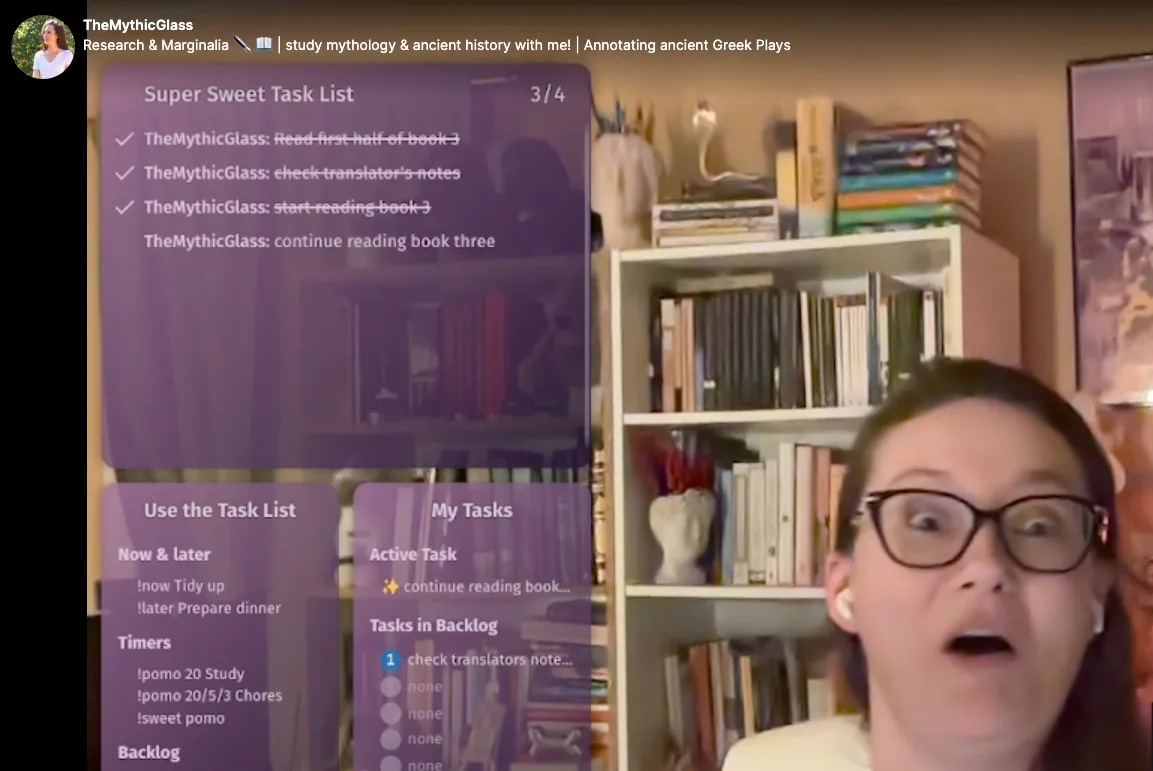
This is a screenshot of a recent livestream, in a delightfully fun place to have paused the video for a screenshot. 😆